The opportunity
The AI buildout is generating demand — for cubic yards, for drivers, for aggregate, for skilled operators, for cement, in markets that weren’t previously sized to provide any of it. Data center construction is not a future event. It is already the largest driver of nonresidential construction starts in the United States, and the pipeline behind it runs for years.
For ready-mix concrete producers operating near data center corridors, this is the most significant demand signal in a generation. The question is whether the supply chain can meet it — and under what conditions.
The scale is different
In the first two months of 2026 alone, U.S. data center construction starts totaled $36.9 billion — compared to $1.4 billion over the same period in 2025.1 The largest technology companies have committed more than $200 billion to data center infrastructure in a single year.2
The physical volume this represents is enormous. A single average hyperscale data center requires approximately 150,000 tons of aggregate.3 The American Cement Association estimates that AI data center construction will require one million metric tons of U.S. cement by 2028 — 247,000 metric tons in 2025 alone.4 These are not projections built on optimistic assumptions. They are derived from announced project pipelines with site permits already filed.
A grid already under pressure
Data centers do not turn off — the load they place on the grid is firm, continuous, and non-curtailable. By 2030, U.S. electricity demand is projected to grow 25%.5 In Texas alone, ERCOT projects demand to reach 218 GW by 2031, primarily driven by data center load — against a 2023 all-time peak of 85,464 MW.6
Power plant construction, transmission infrastructure, and the substations that connect them all require concrete at significant scale. The buildout is not just data halls. It is the full energy infrastructure required to power them.
This makes the local producer the essential, irreplaceable partner in the AI buildout, serving as the critical node where digital processing meets physical reality.
The essential local partner
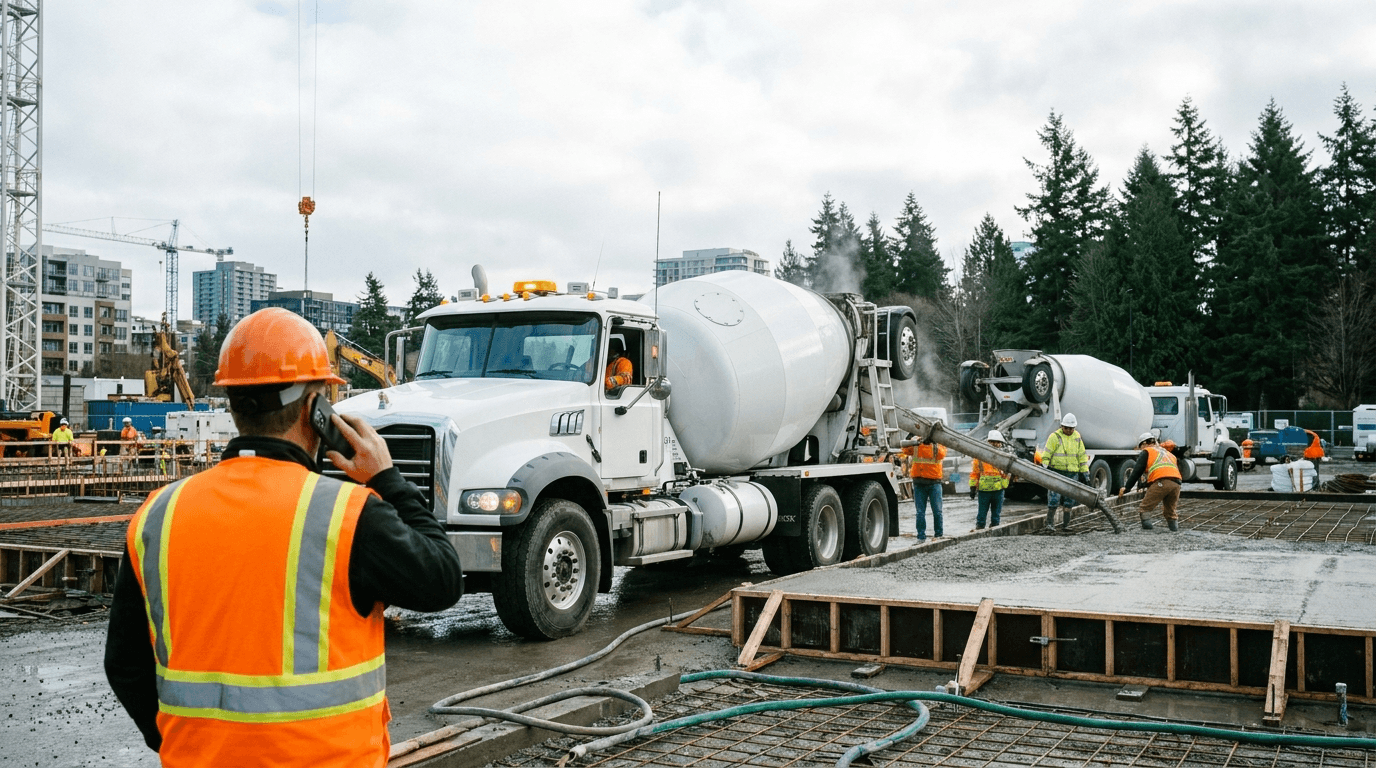
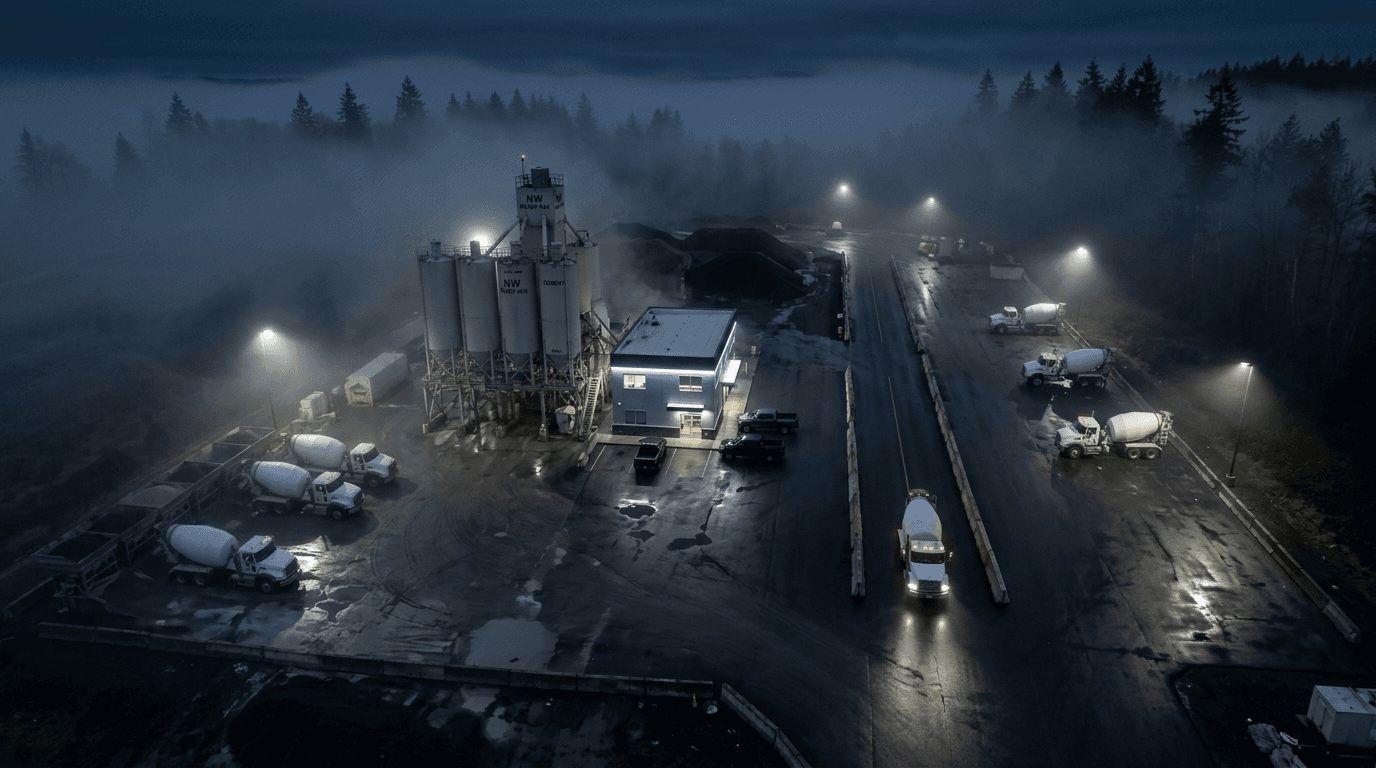
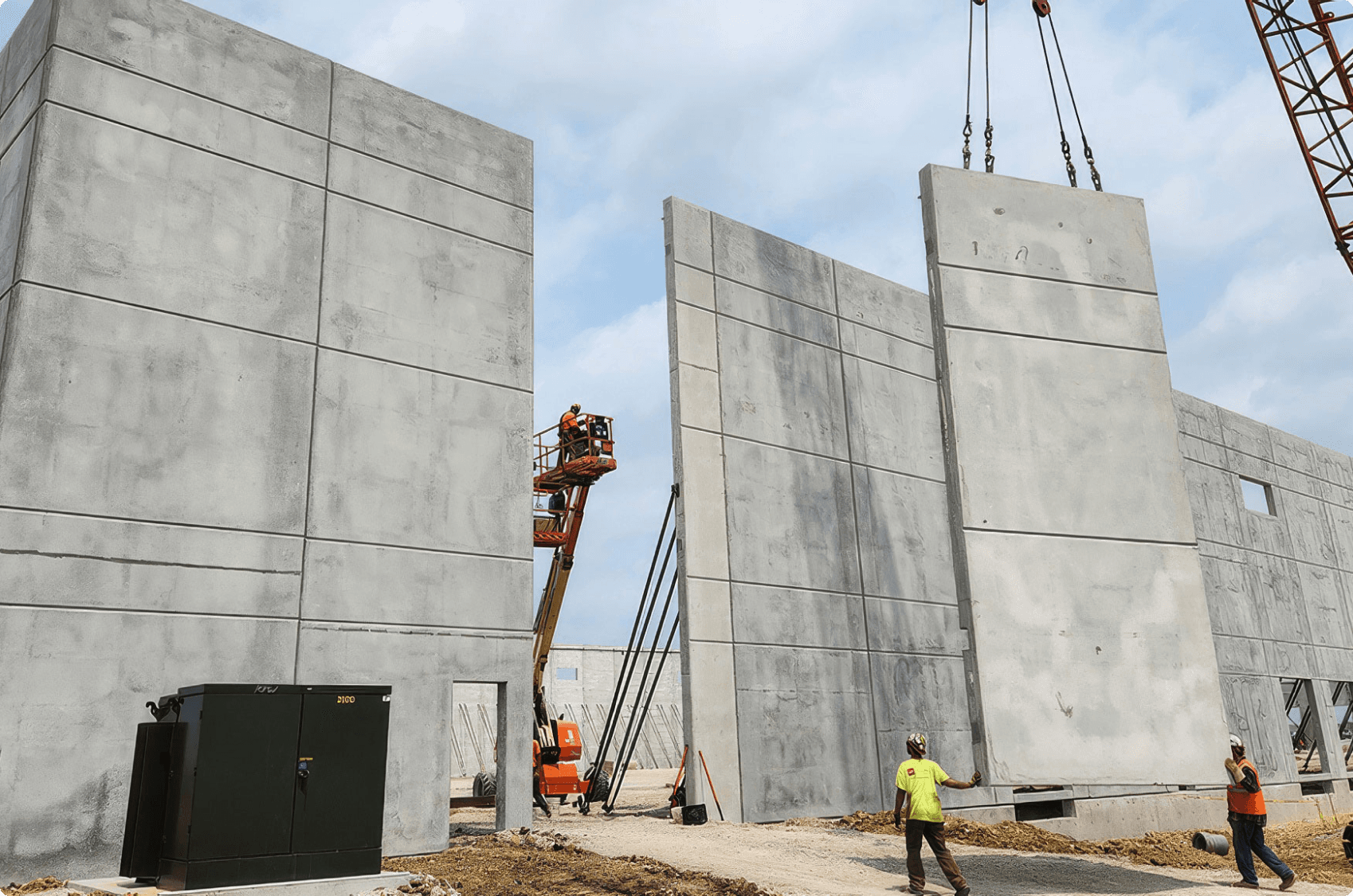
Unlike electrons, which can be transmitted over the power grid to distant data centers, concrete cannot travel. This makes the local producer the essential, irreplaceable partner in the AI buildout, serving as the critical node where digital processing meets physical reality. Because ready-mix is a perishable material that must be placed within a precise window, its value is derived from the producer’s ability to execute complex logistics, material science, and documentation on a strict schedule. This geographic reality elevates the producer from a material supplier to a strategic infrastructure partner whose proximity and performance are fundamental to project success.
The constraints are structural. The supply chain that exists has to do more with what it has. The 75,000 mixer drivers in the U.S. fleet have remained essentially flat for eight consecutive years while production volume has grown 9% over the same period.7 70% of producers report losing business directly due to driver shortages.8 That gap will not be closed by hiring alone.
The full upstream stack
Concrete production is downstream of aggregates, cement, water, and admixtures. Each of those supply chains is itself under pressure. Aggregate quarries near major data center markets face permitting timelines that do not compress on demand. Cement imports depend on port capacity and vessel availability. The 439,000-person construction worker shortage that the ITIF projects as data-center-driven is not limited to concrete — it ripples through every trade on a hyperscale job site.9
For a concrete producer, this environment means that the ability to execute — to deliver the right mix, on time, with documented quality — becomes a competitive differentiator in a way it has not been before. Customers who previously treated concrete as a commodity are writing performance specifications into supply agreements.
A different kind of account
Hyperscaler-adjacent construction is not a series of spot orders. A data center campus is a multi-year, multi-phase project with a general contractor managing a supply chain that the hyperscaler has vetted directly. The specifications are set at the owner level. The relationships are managed across phases. The producers who build that kind of working relationship on Phase 1 are not starting from scratch on Phase 2.
Getting on that approved vendor list requires documented capability — mix design records, quality control history, delivery performance data. Producers who run on informal systems and tribal knowledge face a qualification threshold they have not previously encountered.
A three-party relationship
The hyperscaler sets the performance and sustainability specifications. The general contractor manages procurement and holds the supply chain relationships. The materials producer delivers into that structure across what can be years of continuous work on a single campus.
Each party carries different information. The owner knows the sustainability targets and the long-run commitment. The GC knows the schedule and the critical path. The producer knows the concrete. The coordination surface between those three parties, across a multi-year engagement, is where problems become expensive — and where operational discipline creates lasting advantage.
Precision, carbon, and the new qualification bar
Hyperscalers are not just buying cubic yards. They are buying documented quality and verified carbon performance — and both are increasingly written into contracts. Open Compute Project members have jointly targeted greater than 50% embodied carbon reduction per cubic yard.10 Embodied carbon can account for roughly 40 to 70% of a data center’s lifecycle emissions, and it becomes the largest single source once the facility runs on low-carbon power. Within the building itself, concrete is about 85% of the embodied carbon.11
These are not aspirational targets — they are active qualification criteria that determine which producers can bid on this class of work. AWS has achieved 30% embodied carbon reductions through slag cement substitution on specific projects.12 Equinix has documented roughly 30% reductions in the embodied carbon of its structural materials (steel, concrete, and rebar) against country-average benchmarks.13 The mix-design expertise and documentation to demonstrate compliance is now a market entry requirement for this category of work.
The industry signal: capital is moving
Global construction technology investment reached $6.57 billion in 2025, across 337 deals.14 In the third quarter alone, investment rose 89% year over year, and 83% of the deals involved AI-focused companies.15 CRH has deployed a $250 million ventures fund and has more than 100 active U.S. data center projects.16
The capital flowing into construction technology is not flowing equally. It is concentrating in companies with documented operational performance — producers and contractors who can show that they run well. That advantage compounds: better data enables better models, which enables better execution, which enables more data.
The operational shift
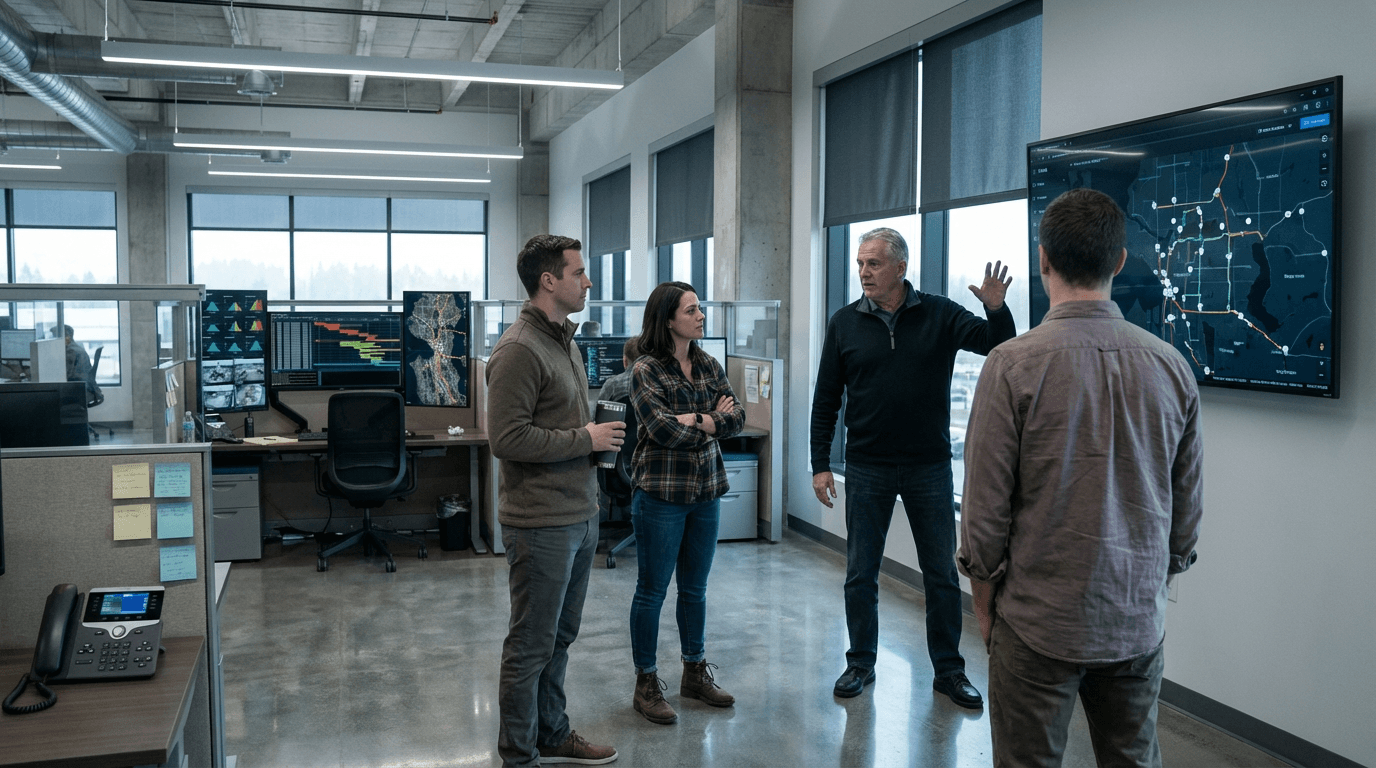
Serving data center construction at scale requires a different operational posture. Shift schedules that accommodate continuous pours. Mix design libraries that can respond to specification changes at the owner level. Delivery performance records that stand up to third-party audit. Driver capacity that can flex with multi-month schedule changes on a single campus.
These are not technology problems. They are operational discipline problems — problems that technology can support, but only if the underlying data quality and decision-making infrastructure is in place. Producers who are still operating on informal systems face a compounding gap: the qualification requirements are rising at exactly the moment when the labor market is tightest and the margin pressure is most acute.
What comes next
The buildout is underway and the constraints are real — there is a need now to invest in closing the gap between the two. AI, appropriately deployed into the operational layers of the concrete supply chain, with genuine subject matter knowledge of how concrete is produced and delivered, is part of how the industry meets that demand.
The producers who qualify for this work, who build lasting relationships with the general contractors managing these projects, and who can deliver documented quality at scale — those producers are not going to be the ones who figured it out in the next procurement cycle. They are already building the operational foundation now.